適合傳承華人孩子的中文學習App:8款誠實對比 (2026)
Best Chinese Learning Apps for Heritage Kids: An Honest Comparison (2026)
海外家長必看:8款中文學習App的真實對比,包括價格、年齡段、優缺點,幫你為孩子選對工具。
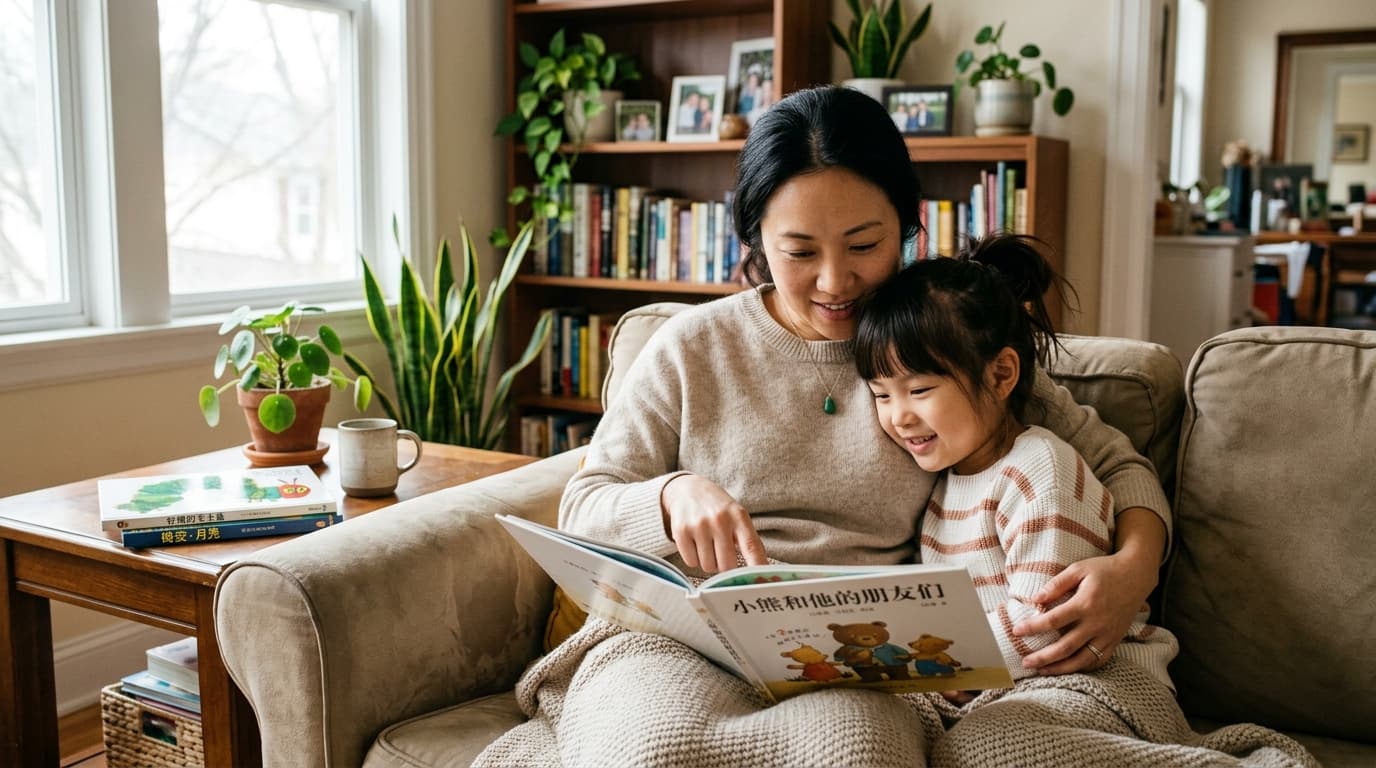
The best Chinese learning app for a heritage kid depends on three things: how old your child is, whether you want a self-paced app or a live tutor, and whether you can read Chinese fluently yourself. Here's how 8 popular options actually compare for overseas families with kids aged 4–10 — based on current pricing, real features, and honest tradeoffs.
We built one of the apps in this list (Boba Chinese), so we've tried to be especially careful to flag where other apps are a better fit. The goal is to help you pick the right tool, not to sell you ours.
The 8 apps at a glance
| App | Format | Age | Pricing (2026) | Parent Chinese needed? | Best for |
|---|---|---|---|---|---|
| Boba Chinese | Self-paced reading app | 4-12 | Subscription, 7-day free trial | No | Independent reading, story-based learning |
| Maomi Stars | Self-paced character game | 4–7 | $7.99–$14.99/mo | No | Cantonese families, gamified character collection |
| Studycat | Self-paced gamified app | 2–8 | $14.99/mo or $59.99/yr | No | Multi-language households (50+ languages) |
| DinoLingo | Self-paced multimedia | 2–14 | $19.99/mo or $199.99/yr | No | Wide age range, video-heavy learning |
| HelloChinese | Self-paced gamified app | 4+ (adult-leaning) | Free + $11.99/mo or $69.99/yr | No | Older kids and self-motivated tweens/teens |
| LingoAce | 1-on-1 live tutoring | 3–15 | ~$15–21/lesson | No | Families who want a real teacher's accountability |
| WuKong Chinese (悟空中文) | 1-on-1 live tutoring | 3–18 | ~$20–29/lesson | No | Families wanting structured live curriculum |
| iHuman Chinese (洪恩識字) | Self-paced character literacy | 3–8 | $6.99–$47.99/yr | Yes — Chinese UI | Mainland-fluent families drilling characters deeply |
There's no universally "best" app on this list. The right choice depends on what your family actually needs — and what your kid will actually open without protest. Below, each app gets a fair short review with honest tradeoffs.
Self-paced apps (5 options)
1. Boba Chinese
What it is: A reading-first app (iOS, Android, and web) that teaches kids 500+ foundational Chinese characters across 20 levels and unlocks 400+ leveled storybooks — every book uses only characters the child has already learned, so there's no guessing or frustration. Designed for overseas heritage families whose kids hear Chinese at home but can't read it yet.
Strengths: The story-based approach is the differentiator. Most character apps drill flashcards in isolation; Boba Chinese turns every lesson into a "win" your child can read on their own from day one. Both Traditional (繁體) and Simplified (簡體) are supported, so families switching between Taiwan, Hong Kong, and the mainland don't have to start over. The parent dashboard requires zero Chinese reading.
Weaknesses (honestly): The curriculum tops out around 500 characters for now — a child already reading chapter books in Chinese will be past it. It's also focused on reading, not on conversational speaking or writing — pair it with FaceTime time with grandparents if oral confidence is your main goal.
Best for: Heritage parents who can't read Chinese themselves, kids aged 4-12 starting from zero, families who want their child to read real Chinese books (not just recognize flashcards).
Skip if: Your child is already reading independently in Chinese, you want live tutoring, or you're prepping for HSK exams.
2. Maomi Stars
What it is: A gamified iOS app for ages 4–7 where kids learn Chinese characters by collecting cats, exploring worlds, and earning gems. Built by a heritage Chinese mom for her own kids, and especially loved by Cantonese families.
Strengths: One of the very few apps that supports Mandarin and Cantonese audio, plus Traditional, Simplified, and Zhuyin (注音). The gamified loop is genuinely fun — kids ask to play. Up to 400 characters across the full curriculum.
Weaknesses: The gem-collection mechanic can become more about the game than the language for some kids. The app is the most direct overlap with Boba Chinese in positioning, so if you want story-based reading specifically (not character collection), Maomi Stars is the wrong tool.
Pricing: Free tier (very limited), Silver $7.99/month, Gold $8.99/month, Gold Plus $14.99/month.
Best for: Cantonese-speaking families, kids who love game mechanics, families who want Zhuyin support.
3. Studycat — Learn Chinese
What it is: A subscription app for ages 2–8 that teaches ~150 Chinese words and phrases through 65 short, gamified lessons. Studycat also offers Spanish, French, German, and 47 other languages on the same platform.
Strengths: kidSAFE certified, ad-free, syncs across iOS and Android, and one subscription supports up to four learner profiles (great for siblings). Strong vocabulary-building approach with audio pronunciation.
Weaknesses: Studycat is more about vocabulary recognition than reading or character writing — your kid will learn words like 蘋果 (apple) and 紅色 (red), but won't progress to reading sentences or stories. The 150-word scope is small if your child is past kindergarten.
Pricing: $14.99/month or $59.99/year, with a 7-day free trial.
Best for: Younger preschoolers (ages 2–5), multi-language households where parents want to introduce Chinese alongside Spanish or French.
4. DinoLingo Chinese
What it is: A web-and-app multimedia program covering ages 2–14, using videos, songs, flashcards, stories, and printable worksheets. Available as part of a 50-language bundle.
Strengths: Very wide age range — same subscription works for a toddler and a tween. Lots of variety in content type, which helps kids who get bored with a single learning format. Web access means it works on any device.
Weaknesses: Because it spans so many ages and 50 languages, the curriculum can feel less specialized for Chinese specifically. The video content is solid but the character-recognition tools are basic compared to dedicated literacy apps like iHuman or Boba Chinese.
Pricing: $19.99/month or $199.99/year (the most expensive on this list, but it bundles 49 other languages).
Best for: Families with multiple kids of widely different ages, families learning more than one second language at once.
5. HelloChinese
What it is: The most popular gamified Chinese-learning app for adults — think "Duolingo for Mandarin." Free to start, with optional Premium tiers.
Strengths: Excellent free tier — you can make real progress without paying. Speech recognition for tone practice. Strong grammar progression. Beautifully designed.
Weaknesses: Not designed for young kids. The gamified streak mechanics, written instructions, and grammar focus assume an independent reader who can self-direct. It's age-rated 4+ on the App Store, but in practice, most kids under 9 will struggle to navigate it without help.
Pricing: Free + Premium $11.99/month or $69.99/year, plus a Premium+ tier with more advanced features.
Best for: Tweens and teens who can self-direct, motivated 10+ year olds, parents who want to learn Chinese alongside their kids.
6. iHuman Chinese (洪恩識字)
What it is: A character-literacy app from a major mainland Chinese education company, teaching up to 1,300 Chinese characters through animations, songs, and 130 leveled picture books.
Strengths: The most comprehensive character drilling on this list. 1,300 characters is roughly the vocabulary of a Chinese first-grader. The animation production quality is excellent. Free trial with 20 words and 2 leveled readers gives a real preview.
Weaknesses: The interface and instructions are entirely in Chinese. If you can't read Mandarin, navigating the app is genuinely hard, and helping your child stuck on a level requires Google Translate. Designed for kids in China, so the cultural context (and the fact that it's Simplified-only) may not fit overseas families as cleanly. Payment requires WeChat Pay, Alipay, or App Store on iOS.
Pricing: $6.99/month, $18.99/3-months, $47.99/year, and a ~$80 lifetime tier.
Best for: Mandarin-fluent parents who want their child to drill characters deeply, mainland-leaning families, kids preparing to enter a Chinese-medium school.
Live tutoring (2 options)
7. LingoAce
What it is: A 1-on-1 live online tutoring service for kids ages 3–15. Teachers are certified, classes are structured around a fixed curriculum, and lessons happen on a video-call platform.
Strengths: Real human accountability. A teacher who notices when your kid is struggling and adjusts. Better for kids who need external structure than self-paced apps. Forbes recognized them in 2025 as an Influential Brand in Education.
Weaknesses: Cost adds up fast — even at the lower end ($14–21/lesson), two lessons a week is $112–168/month, an order of magnitude more than any self-paced app. Schedule pressure: a missed lesson is a sunk cost. Teacher quality varies by region.
Pricing: Roughly $14–21 per 25 or 55-minute lesson, sold in packages.
Best for: Families who can afford it, kids who need external accountability to stay consistent, parents who want a human in the loop.
8. WuKong Chinese (悟空中文)
What it is: LingoAce's biggest competitor in 1-on-1 online Chinese tutoring. Same model: certified teachers, fixed curriculum, video lessons. Slightly more popular among diaspora Chinese families on Mandarin parenting forums.
Strengths: Curriculum is well-designed for non-native Chinese-speaking diaspora children, covering character recognition, pinyin, sentence patterns, and Chinese cultural knowledge. All teaching materials are included in tuition. Free 30-60 minute trial class.
Weaknesses: Scheduling can take 1–2 weeks initially. Same cost concern as LingoAce — tutoring is the most expensive route.
Pricing: Roughly $20–29 per lesson, in packages of $349 (12 sessions) or $1,349 (60 sessions).
Best for: Families willing to invest in live lessons, parents who want a structured curriculum delivered by a real teacher.
Why bilingual learning matters (the research)
Before you pick any app, it helps to know what the research actually says about heritage language learning.
The American Academy of Pediatrics confirms that exposing kids to two languages from infancy does not cause language delays or confusion — a myth that has unfortunately discouraged many heritage parents from teaching their first language at home. Bilingual children may temporarily mix languages between ages 3 and 6, but they go on to develop stronger executive function, attention control, and cognitive flexibility than monolingual peers, according to research published in the journal Bilingualism: Language and Cognition.
A 2018 MIT study by Hartshorne, Tenenbaum, and Pinker — analyzing data from 2/3 million English speakers — found that the critical period for learning second-language grammar extends to roughly age 17, not "before age 7" as the older folk-wisdom claimed. That means it's not too late to start at age 8, age 10, or even later. What matters more is consistency and emotional positivity, not the exact start age.
The takeaway: any of the apps on this list will move the needle if your child uses it consistently for 10–15 minutes a day. The bigger predictor of success is whether your kid will actually open the app — not which app you bought.
How to pick the right one
A simple decision tree:
- Can you read Chinese fluently yourself?
- No → skip iHuman (Chinese-only UI). Boba Chinese, Maomi Stars, Studycat, DinoLingo, and the live tutoring services are all designed for non-Chinese-reading parents.
- What's your monthly budget?
- Under $20/month → self-paced apps (Boba Chinese, Maomi Stars, Studycat, HelloChinese)
- $100+/month → live tutoring (LingoAce or WuKong)
- What's your child's age?
- 2–4 years → Studycat or DinoLingo (designed for the youngest learners)
- 4–7 years → Boba Chinese, Maomi Stars, or iHuman (if parent reads Chinese)
- 8–10+ → HelloChinese or live tutoring (the self-paced kid apps will feel babyish)
- What's your goal?
- Reading real books independently → Boba Chinese
- Cantonese support → Maomi Stars (one of the only options)
- Deep character drilling (1,000+ characters) → iHuman, if parent reads Chinese
- Vocabulary and pronunciation → Studycat or HelloChinese
- External accountability → LingoAce or WuKong
The most successful families combine more than one tool: a self-paced app for daily practice (10 minutes) plus FaceTime with grandparents for oral input plus a real Chinese book at bedtime. Apps work, but they work best as one ingredient in a broader habit.
Frequently asked questions
What's the best free app to learn Chinese for kids?
HelloChinese has the strongest free tier — you can genuinely make progress without paying. iHuman Chinese gives you a free trial of 20 words and 2 leveled readers. Most other apps on this list (Boba Chinese, Studycat, DinoLingo, Maomi Stars) offer 7-day free trials so you can test them without committing.
My kid has never learned any Chinese. Where should I start?
Start with a self-paced app designed for absolute beginners (Boba Chinese, Maomi Stars, Studycat, or DinoLingo) and aim for 10 minutes a day for the first month. Don't overload your kid with multiple apps at once — pick one, build the habit, then add a second tool only if needed.
Are 1-on-1 lessons worth it compared to a self-paced app?
It depends on what your kid needs. A live teacher is unbeatable for kids who need external accountability or struggle to stay consistent on their own. But a self-paced app gives you 30+ days of practice for the cost of one tutoring session — and many heritage kids learn just as well from a well-designed app, especially in the early years.
How long does it take a kid to learn 200 Chinese characters?
With consistent 10-minute-daily practice, most heritage kids learn the first 200 characters in roughly 3–6 months, then keep climbing through the rest of the 500. Speed varies based on age, prior exposure, and emotional engagement — kids who like the app tend to go 2–3x faster than kids who feel forced.
Should I pick Traditional or Simplified Chinese for my child?
Both are valid. Choose based on your family's heritage, the community you're in, and whether your child may visit Taiwan, Hong Kong, or mainland China. Traditional and Simplified share roughly 70% character overlap, so exposure to one helps the other. Boba Chinese and Maomi Stars both support both scripts in-app so kids can switch without re-learning.
My kid resists Chinese. Will any app fix that?
No app alone will fix resistance — but apps can help by removing pressure. Resistance peaks between ages 5 and 10 (when fitting in matters more than anything) and is usually about identity, not the language itself. The best move is to drop the "you have to learn Chinese" framing and instead pair Chinese with something your kid already loves: dinosaurs, Minecraft, K-pop, dumplings with grandma. Apps work best when they feel like a choice, not a chore.
Is iHuman Chinese (洪恩識字) good for non-Chinese-speaking parents?
Honestly — no. The app's UI and instructions are entirely in Chinese, so navigating it without Mandarin reading skills is genuinely difficult. If you can't read Chinese, choose a more accessible option like Boba Chinese, Maomi Stars, Studycat, or DinoLingo.
The bottom line
There's no single "best" Chinese learning app for heritage kids — there's only the right fit for your family's age, budget, language fluency, and learning goals. If you want our honest summary:
- For 4-12 year olds whose parents don't read Chinese and want their kid to read real books → Boba Chinese (we built it for exactly this profile).
- For Cantonese families or families wanting Zhuyin → Maomi Stars.
- For Mandarin-fluent parents wanting deep character work → iHuman.
- For 2–5 year olds in multi-language families → Studycat.
- For older kids and self-directed learners → HelloChinese.
- For families who want a real teacher → LingoAce or WuKong.
The best app is the one your kid will actually open tomorrow. Try a free trial of two or three before committing.
Sources: American Academy of Pediatrics statements on bilingual development; Bilingualism: Language and Cognition (Cambridge University Press); Hartshorne, J.K., Tenenbaum, J.B., & Pinker, S. (2018). "A critical period for second language acquisition: Evidence from 2/3 million English speakers." Cognition, 177, 263–277.